
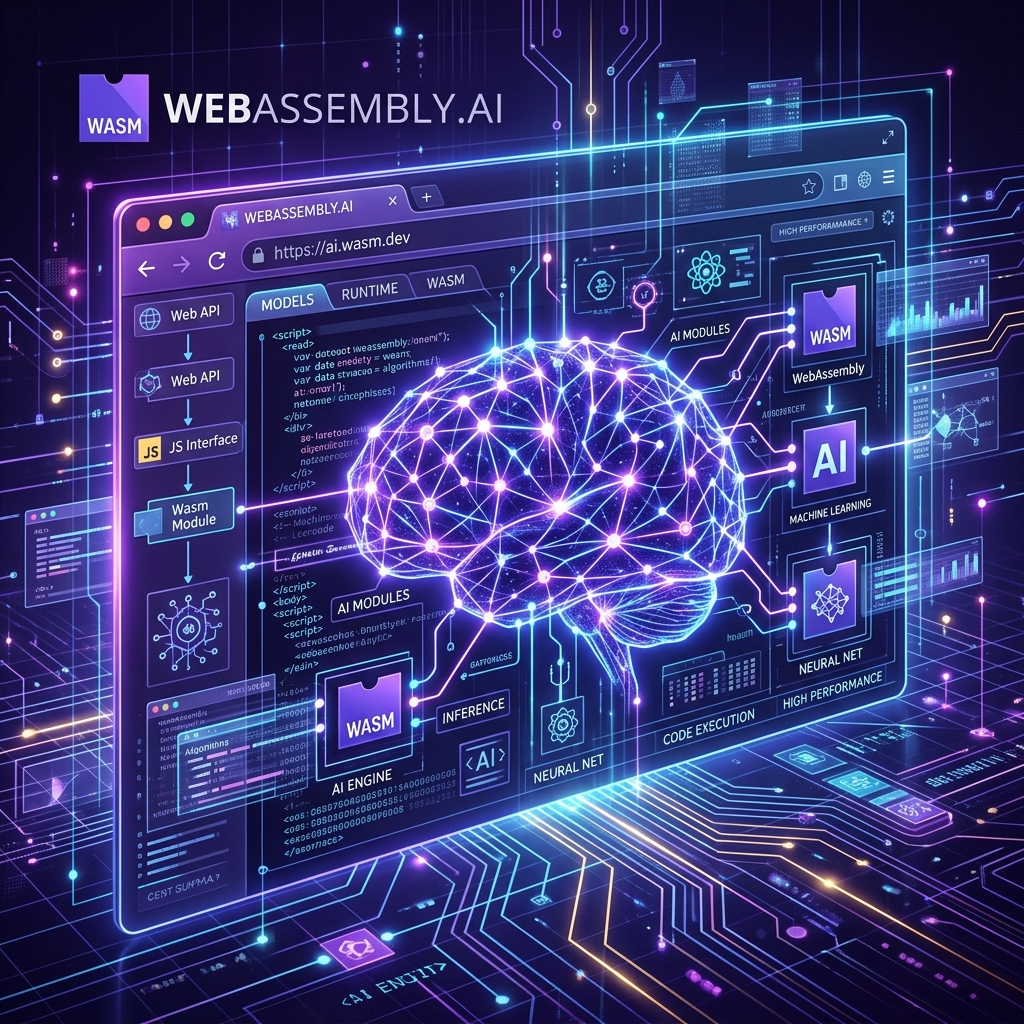
The web browser is no longer just a document viewer or a light application platform. In 2026, the convergence of WebAssembly (WASM), WebGPU, and WebNN has turned browsers into high-performance execution environments capable of running large neural networks locally. This shift promises to redefine the distribution of AI intelligence across the web.
The Evolution of Browser Execution
For years, running AI workloads meant building complex, expensive backend infrastructures. Sending audio for speech-to-text, images for object detection, or prompts for text generation to cloud servers introduced substantial network latency, cost scaling concerns, and security compliance overhead. While JavaScript-based libraries like TensorFlow.js made initial browser inference possible, they struggled with the raw computational demands of modern deep learning models.
WebAssembly (WASM) solved the execution bottleneck by providing a binary instruction format that runs at near-native speeds in sandboxed browser environments. By compiling highly optimized C++ or Rust machine learning runtimes directly to WASM, developers unlocked unprecedented local execution speeds.
"By shifting neural network execution from remote data centers directly into the client's browser using WebAssembly and WebGPU, we eliminate server hosting costs while providing users with instantaneous, private AI experiences." — Innogreets Web & AI Architects
The Catalyst Trio: WASM, WebGPU, and WebNN
Running complex AI models in the browser requires a combination of high-speed execution, hardware acceleration, and specialized neural network abstraction. In 2026, three technologies work together to make this possible:
- WebAssembly (WASM) with SIMD: Provides the binary foundation, allowing runtimes like ONNX Runtime Web to run compiled C++ model execution graphs locally with Single Instruction Multiple Data (SIMD) vector acceleration.
- WebGPU: The successor to WebGL, WebGPU gives browsers low-level access to the device's graphics card (GPU). This enables massive parallelization of matrix multiplication, speeding up inference by orders of magnitude.
- WebNN (Web Neural Network API): An emerging web standard that abstracts hardware capabilities, allowing browsers to route neural network operations directly to NPUs (Neural Processing Units) or GPUs via native system APIs like CoreML, DirectML, and Android NNAPI.
Why Run AI Locally in the Browser?
Shifting from cloud-based AI to browser-side local execution brings remarkable advantages for modern web applications:
- Zero Server Costs: Since computation runs on the user's local CPU, GPU, or NPU, the application owner does not pay server hosting or API inference bills. Scaling to millions of active users becomes virtually free.
- Guaranteed Data Privacy: Sensitive documents, video feeds, and voice transcripts never leave the user's browser. This guarantees absolute privacy and complete compliance with tight data regulations like GDPR.
- True Offline Execution: AI features remain fully functional in environments with intermittent, low-speed, or completely absent internet connections, such as field operations or transit.
- Sub-Millisecond Latency: Eliminating round-trip network hops makes features like real-time gesture tracking, video background blurring, and local autocomplete feel incredibly snappy.
Prominent Use Cases in 2026
We are already seeing incredible web apps leveraging browser-side WASM AI. Online video editors perform complex semantic mask selections and chroma key removal directly in the browser. In-browser audio transcribers leverage Whisper models compiled to WASM to transcribe voice meetings locally and securely. Interactive coding sandboxes execute local code suggestions, and graphic design tools perform smart vector object extractions—all running at 60 FPS in standard browser tabs.
Conclusion
The combination of WebAssembly and local hardware acceleration is breaking down the walls of traditional cloud-heavy AI architectures. For businesses looking to scale AI-powered products, utilizing WASM to deploy models on the client side is a game-changing strategy that reduces operational costs, enhances privacy, and builds incredibly responsive products. At Innogreets, we are actively implementing browser-side machine learning models to help our clients build the next generation of intelligent web applications.